
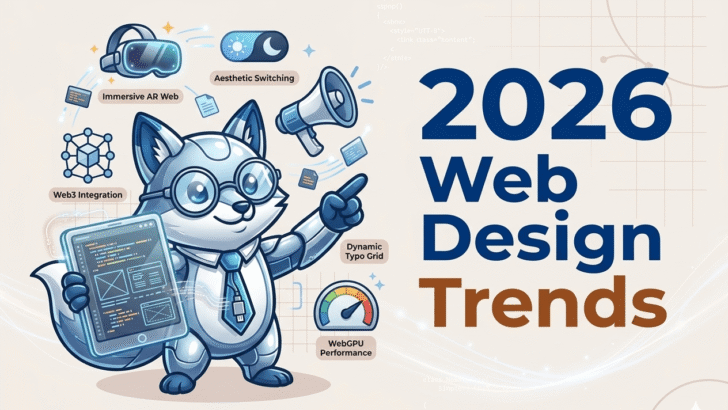
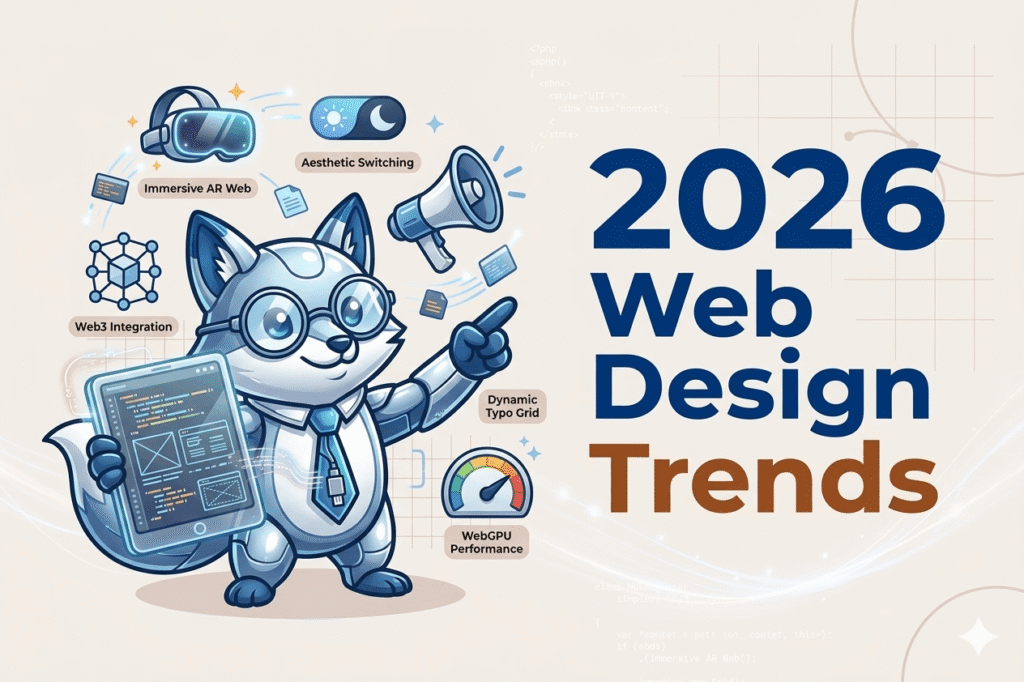
Alt Text: 2026 Website Trends | Source: TypeTasty Design
2026 Web Design Trends: The Rise of Subjective UI and Organic Typography
As we cross into 2026, the digital world is experiencing a profound “Great Awakening.” For nearly a decade, web design was trapped in a cycle of extreme utility—flat buttons, grid-locked layouts, and the ubiquitous, soul-less sans-serif. While this era was great for speed, it was terrible for brand soul.
In 2026, the pendulum is swinging back. At TypeTasty, we’ve identified a core shift: users are no longer satisfied with “functional” websites; they are looking for “felt” experiences. This is the era of Subjective UI—a design philosophy that prioritizes character, emotion, and organic flow over robotic perfection.
Here is your comprehensive guide to the Web Design Trends of 2026 and how you can stay ahead of the curve.
1. The Death of the “Grid-Standard” (Liquid Layouts)
For years, we built websites like we were building spreadsheets. Everything had to fit into a 12-column grid. In 2026, we are seeing the rise of Liquid Layouts. Instead of rigid boxes, web assets are now flowing into each other. Images overlap with text, and background elements move in “non-linear” patterns as you scroll. This creates a sense of discovery. When a user lands on a site, they don’t feel like they are looking at a template; they feel like they are exploring a digital gallery.
Why it works for SEO: Google’s 2026 algorithms are increasingly focusing on “User Delight” and “Dwell Time.” A liquid layout encourages deeper scrolling and longer engagement, signaling to search engines that your content is high-quality and unique.
2. Subjective UI: Designing for the Ego
Subjective UI is the most significant trend of the year. Unlike Objective UI (which focuses on being invisible), Subjective UI wants to be noticed. It uses bold stylistic choices—like heavy ink-trap typography and asymmetrical doodles—to create a “Mood.”
In 2026, a website’s job isn’t just to provide info; it’s to make the user feel like they belong to a specific tribe. Are you an “Organic Minimalist” or a “Digital Rebel”? Your UI must tell that story immediately.
At TypeTasty, we focus on fonts that drive this trend. An Organic Serif isn’t just a font; it’s a subjective choice that signals luxury, history, and human craftsmanship.
3. The “Tactile Digital” Experience
Even though we are looking at glass screens, we want to feel texture. In 2026, web design is leaning heavily into Grain, Noise, and Paper Textures.
Backgrounds are no longer #FFFFFF (Pure White). They are Broken White, cream, or textured linen. This reduces eye strain and gives the website a “physical” presence. When paired with high-quality typography, it makes the digital experience feel like reading a high-end physical magazine.
Key Aesthetic:
- Background: Off-whites and muted earth tones.
- Foreground: High-contrast, textured serifs.
- Accents: Hand-drawn “Organic Doodles” that replace generic stock icons.
4. Typographic Hero Sections (Typography as Art)
In the past, the hero section was always a “Stock Photo + Headline.” In 2026, the typography is the hero.
We are seeing designers use massive, screen-filling fonts—often TypeTasty’s signature scripts or serifs—as the primary visual element. The words are so beautiful that you don’t need a photograph. This trend is incredibly efficient for mobile loading speeds (LCP) because you aren’t loading heavy 4K images, yet the site looks more premium than ever.
5. Kinetic Typography and Micro-Interactions
Static text is a thing of the past. In 2026, text lives. As you hover over a heading, the serif might “grow” or the letters might subtly shift as if they are floating in water. These are called Micro-Interactions.
These tiny movements provide “dopamine hits” to the user, making the navigation process addictive. When the user feels that the website is “responding” to them, the trust level increases exponentially.
6. Strategic Subjective Content: The Human Filter
Because AI can now generate 10,000 blog posts in an hour, the value of “Objective Information” has hit zero. In 2026, people come to websites for the Human Filter.
Your blog shouldn’t just list facts. It should provide Opinions. * Bad: “How to choose a font.”
- Good: “Why I hate 90% of modern web fonts (and what I use instead).”
The 2026 user wants to follow people and brands with a “vibe.” This is why TypeTasty succeeds—we don’t just sell fonts; we sell a philosophy of “Imperfection over Perfection.”
7. Inclusive Personalization (AI-Co-Creation)
By late 2026, websites will start to change based on the user’s specific “Taste Profile” (with consent). If the system knows you prefer minimalist aesthetics, the site might automatically simplify its layout and shift to an Organic Serif weight that is easier on your eyes.
This isn’t just “Dark Mode” vs. “Light Mode.” This is Adaptive Aesthetic Design. As a designer, your job is to create a “Brand System” that can flex and move while maintaining its core soul.
8. The “Organic Doodle” Aesthetic
Forget the “Corporate Memphis” flat illustrations of 2020. 2026 is the year of the Ink Sketch. Abstract, hand-drawn lines, scribbles, and “doodles” are being used to guide the eye toward Call-to-Action (CTA) buttons. It feels personal. It feels like the brand was “sketched” specifically for you.
Section 9: Why Your Typography Choice is a Business Decision
Many designers treat font selection as the “final step.” In 2026, it is the first step. Your typeface is the “voice” of your website. If you are using a standard system font, you are speaking in a monotone, robotic voice. If you use a custom, high-character serif from TypeTasty, you are speaking with authority, warmth, and luxury.
In a world where everyone is fighting for 3 seconds of attention, your “visual voice” is the only thing that will make them stay.
Section 10: Conclusion – Designing the Future
Web design in 2026 is no longer about “fitting in.” It is about standing out. By embracing Subjective UI, Liquid Layouts, and Organic Typography, you are telling your audience that your brand has a soul. You are telling them that you aren’t just another AI-generated business, but a human-led creative powerhouse.
The grid is gone. The sterile white background is over. The era of the TypeTasty aesthetic—imperfect, organic, and deeply human—is here.
Are you ready to design for 2026? Start by choosing a font that has something to say.